


A sharp fade can completely change the look of a men’s haircut. When the fade starts higher on the sides and back, it creates stronger contrast and gives the hairstyle a clean, modern appearance. The high fade is a popular choice for men who want shorter sides without sacrificing styling options on top.
It works with short crops, curls, waves, buzz cuts, quiffs, pompadours, slick backs, fringes, and many other hairstyles. One of the biggest advantages of this haircut is its versatility. The top can be customized according to your hair texture, face shape, lifestyle, and personal preference.
What Is a High Fade?
A high fade is a men’s haircut where the transition from longer hair to shorter hair begins high on the sides of the head, usually around the temples or upper sides. The hair gradually becomes shorter as it moves toward the ears and neckline. The shortest section can reach the skin or remain slightly longer for a softer shadow effect.
Because the fade starts higher than a low or mid fade, it removes more bulk from the sides. This creates a noticeable contrast between the top and the faded area. The haircut can be customized with different lengths, textures, hairlines, and neckline finishes.
Best High Fade Haircuts for Men
Classic High Fade
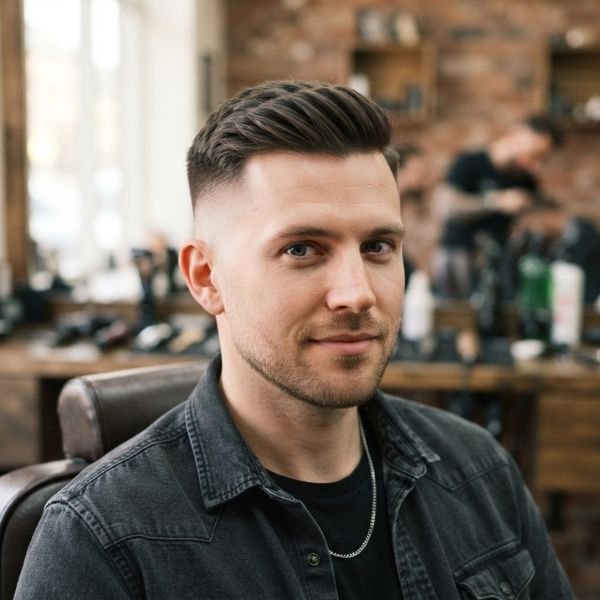
The classic version keeps the sides and back clean while leaving enough length on top for everyday styling.
The transition should be smooth and proportional rather than pushed unnecessarily high.
Best for: Straight, wavy, and thick hair
High Skin Fade
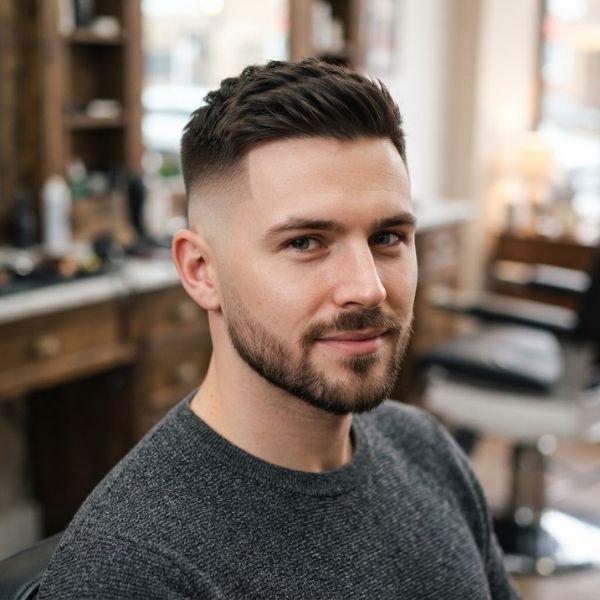
A skin fade takes the shortest section down to the scalp.
This creates maximum contrast and gives the haircut an especially sharp appearance. It works well with textured tops, short crops, and longer styles.
Best for: Bold and modern looks
High Shadow Fade

A shadow finish leaves a small amount of hair at the shortest point.
This creates a softer appearance than a skin fade while maintaining the strong contrast associated with the haircut.
Best for: Men who want a cleaner look without exposed skin
High Taper Fade

A high taper keeps more natural hair around certain areas while creating a controlled transition around the temples and neckline.
It is a good option for men who want a cleaner haircut without removing as much hair from the sides.
Best for: Professional and versatile styles
High Fade Buzz Cut

A buzz cut is one of the easiest hairstyles to combine with a high fade.
The short top requires minimal styling, while the faded sides give the haircut additional shape and definition.
Best for: Low-maintenance hairstyles
High Fade Crew Cut

A crew cut leaves more length toward the front and top than a traditional buzz cut.
You can brush the hair forward, upward, or slightly to the side depending on the desired finish.
Best for: Straight and wavy hair
High Fade Textured Crop

A textured crop combines short hair on top with choppy, separated texture.
The contrast between the textured top and clean sides creates a contemporary appearance.
Use a small amount of matte clay or texture powder to emphasize the individual strands.
Best for: Thick and straight hair
High Fade French Crop
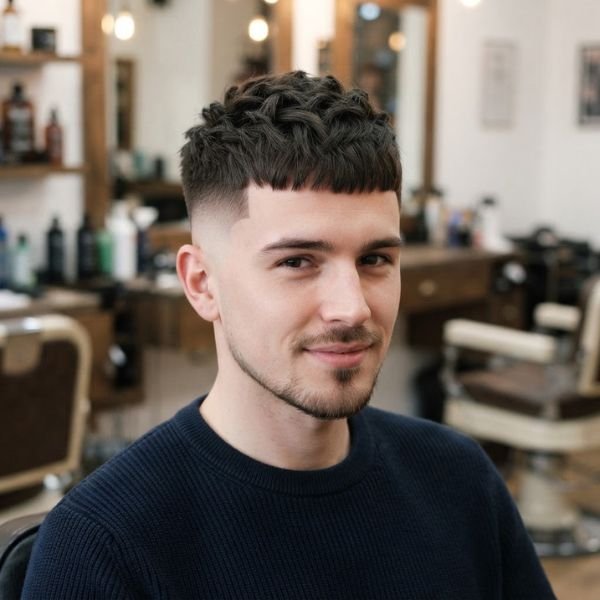
The French crop features a short top with a forward fringe.
Keeping the sides very short makes the fringe more noticeable and gives the haircut a strong silhouette.
Best for: Straight, thick, and slightly wavy hair
High Fade With Fringe
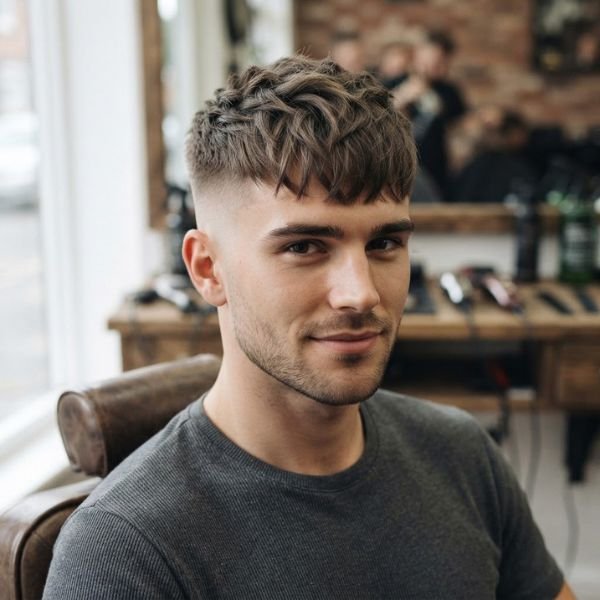
A fringe can be worn straight, textured, messy, or slightly angled across the forehead.
The shorter sides prevent the hairstyle from appearing too heavy and help emphasize the shape of the fringe.
Best for: Straight, thick, and wavy hair
High Fade Quiff

A quiff creates volume toward the front while keeping the sides considerably shorter.
This combination works especially well when you want a hairstyle that looks polished but still has plenty of personality.
Best for: Medium and thick hair
High Fade Pompadour
A pompadour requires length and volume on top.
The shorter sides make the top appear fuller and give the hairstyle a modern contrast. Blow-drying and a strong styling product can help maintain the desired shape.
Best for: Thick, straight, and wavy hair
High Fade Slick Back
The slick back keeps the top longer and directs the hair backward.
A matte product creates a modern appearance, while a small amount of shine can produce a more traditional finish.
Best for: Straight and wavy hair
High Fade Comb Over
A comb over offers a polished appearance and can be adapted for both casual and professional settings.
The longer top can be swept across the head while the sides remain tightly blended.
Best for: Straight and slightly wavy hair
High Fade Side Part
A defined side part gives the haircut a classic structure.
You can combine the part with a hard line for extra definition or keep it natural for a softer appearance.
Best for: Straight and wavy hair
High Fade With Curly Top
Curly hair provides natural volume and texture on top.
Keeping the curls longer while shortening the sides creates a strong contrast. Use curl cream or leave-in conditioner to keep the curls defined.
Best for: Curly and coily hair
High Fade With Waves
Waves can look particularly sharp when paired with clean sides.
The top should retain enough length to maintain the wave pattern, while the sides are gradually reduced.
Best for: Wavy and coily hair
High Fade With Afro
An afro combined with a clean fade creates a strong shape around the head.
The natural volume stays on top while the sides are reduced to create definition.
Best for: Coily and tightly textured hair
High Fade Mohawk
A mohawk keeps significantly more length through the center of the head.
The sides are cut much shorter, making the central strip of hair the main feature of the haircut.
Best for: Thick and textured hair
High Fade Faux Hawk
A faux hawk provides the appearance of a mohawk without requiring an extreme cut.
The center is styled upward while the shorter sides create contrast.
Best for: Straight, wavy, and thick hair
High Fade With Beard
A beard can add balance to a sharp fade by creating more definition around the lower face.
The sideburns can be blended gradually into the beard for a connected appearance.
Best for: Short, medium, and full beards
High Fade With Line Up
A lineup creates sharp edges around the forehead and temples.
When combined with clean faded sides, it gives the haircut a precise and structured appearance.
Best for: Short and thick hair
High Fade for Different Hair Types
Straight Hair
Straight hair makes the transition of the fade easy to see.
You can pair it with a crop, side part, slick back, quiff, pompadour, or fringe.
Wavy Hair
Wavy hair adds natural movement and texture.
Keeping some length on top allows the waves to remain visible while the shorter sides provide structure.
Curly Hair
Curly hair works well because the natural volume contrasts with the clean sides.
Do not remove too much length from the top if you want the curls to maintain their shape.
Coily Hair
Coily hair can be styled with short curls, waves, twists, an afro, or other textured hairstyles.
The fade provides a clean frame while allowing the natural texture to remain the focus.
Fine Hair
Fine hair can also work with this haircut.
Keeping moderate length on top and adding texture can make the hair appear fuller. Avoid making the top excessively long if it lacks natural density.
High Fade vs Low Fade
The main difference is the position where the fade begins.
A low fade starts closer to the ears and lower sides, creating a subtle transition.
A high fade begins farther up the sides, resulting in stronger contrast and a more noticeable change in length.
Choose a low fade if you prefer a conservative appearance. The higher option is better suited to men who want the sides to look significantly shorter.
High Fade vs Mid Fade
A mid fade sits between a low and high fade.
It provides a balanced transition and works with many hairstyles.
The higher option creates more contrast because the shortest section reaches farther upward. Your choice should depend on how dramatic you want the haircut to look.
High Fade vs Skin Fade
These terms describe different parts of a haircut.
The word “high” refers to the position of the fade, while “skin” describes how short the hair becomes.
Therefore, a haircut can have a high fade with a skin finish or a shadow finish.
Is a High Fade Good for Your Face Shape?
The haircut can suit many face shapes, but the styling of the top should be adjusted to create balanced proportions.
Round Face
Adding moderate height on top can make the face appear longer.
Textured quiffs and controlled pompadours can work well.
Oval Face
Most variations work well with an oval face because the proportions are naturally balanced.
Square Face
Short textured styles can complement a strong jawline and angular facial structure.
Long Face
Avoid excessive height if your face is already long. Keeping more natural volume on top can create better balance.
Heart-Shaped Face
A slightly fuller top can help balance a narrower chin and broader upper face.
How to Ask Your Barber for the Haircut
Good communication is important because the exact height can vary between barbers.
You can say:
“I want the fade to start high around the temples, with a smooth transition into the sides and back. Keep enough length on top for my chosen hairstyle.”
Then discuss:
- Skin, shadow, or regular finish
- Top length
- Hairline shape
- Temple area
- Neckline
- Beard connection
- Lineup
- Texture
- Any shaved design
A reference photo can also help your barber understand the exact level of contrast you want.
How to Style a High Fade
Styling mainly depends on the length and texture left on top.
For short hair, matte clay or texture powder can add definition without making the hair greasy.
For medium hair, blow-drying can help create direction and volume before applying styling products.
For curly hair, curl cream or leave-in conditioner can improve definition and reduce frizz.
Longer styles such as pompadours, quiffs, and slick backs may require a stronger styling product and a blow dryer.
The faded sides generally require little styling. Most of your daily effort should focus on maintaining the top.
How Often Should You Maintain It?
A freshly cut fade usually looks its sharpest during the first one to two weeks.
For men who prefer a consistently clean appearance, a barber appointment every two to three weeks is a practical schedule.
You can wait longer if you prefer a softer grow-out.
The shorter the fade, the more noticeable new growth can become around the temples and sides.
Common Mistakes to Avoid
Taking the Fade Too High
Going excessively high can change the proportions of the haircut and leave less usable length around the sides.
Choosing Too Much Length on Top
The top should suit your hair density, texture, and styling ability.
Ignoring Natural Hair Growth
Cowlicks and uneven growth patterns should be considered when deciding where the transition should begin.
Using Too Much Product
Heavy product can make textured hair look greasy and flat.
Skipping Maintenance
As the sides grow out, the contrast becomes less defined and the haircut can lose its freshly cut appearance.
Copying Another Person’s Haircut
The same style may look different depending on hair texture, density, face shape, and head shape.
Frequently Asked Questions:
What is a high fade?
It is a men’s haircut where the fade begins high on the sides, generally around the temples or upper sides of the head.
Is a high fade good for thick hair?
Yes. It removes excess bulk from the sides while allowing you to keep useful length and texture on top.
Can curly hair work with a high fade?
Yes. Curly hair creates natural volume that contrasts nicely with shorter sides.
What is the difference between a high fade and a skin fade?
A high fade describes where the transition begins, while a skin fade describes how short the hair becomes at the shortest point.
How long does a high fade last?
The haircut can remain wearable for several weeks, although the sharpest appearance usually lasts around one to two weeks.
Can I combine a high fade with a beard?
Yes. The sideburns can be blended into the beard to create a connected and balanced appearance.
Is a high fade professional?
Yes, when it is kept clean and paired with a polished top such as a side part, comb over, or slick back.
Can I get a high fade with a buzz cut?
Yes. A buzz cut with faded sides is simple, masculine, and easy to maintain.
Should I choose a high or mid fade?
Choose the higher option if you want stronger contrast and shorter sides. A mid fade is better if you prefer a more balanced transition.
How often should I get it cut?
Every two to three weeks is a good maintenance schedule for keeping the fade sharp.
Conclusion
A high fade gives men a clean and noticeable haircut foundation that works with a wide range of hairstyles. You can combine it with a buzz cut, crew cut, textured crop, fringe, quiff, pompadour, slick back, curls, waves, afro, mohawk, or longer top. The finish can also be customized according to your preferred level of contrast.
The best result depends on choosing the right height and top length for your hair texture and face shape. A skilled barber can adjust the transition so the haircut looks balanced rather than simply removing as much hair as possible. If you want a modern men’s haircut with clean sides, strong contrast, and plenty of styling possibilities, this fade is an excellent option.

Oliver Matthew Wilson is a fashion writer and content creator passionate about modern style, fashion trends, outfit ideas, and everyday inspiration. He enjoys sharing practical fashion insights and fresh styling ideas to help readers discover their personal style with confidence.